Sunday, 13 September 2015

Midpointness


Midpointness


 Sydney. Coming into focus. Slowly. 


Day one.

I have been invited by the University of Newcastle, Australia, as a Visiting Professor to undertake a residency ( http://www.thelockup.org.au/whats-on ) at The Lock-Up Culture Centre. Working closely ( as closely as one can in the digital realm ) with Andrew Bracey in the UK, I will be developing the first incarnation of the midpointness project for a short exhibition at the Lock Up followed by presenting the key note at the two day conference;

NEXT TO NOTHING: ART AS PERFORMANCE
A meeting of art and philosophy in the age of post-dematerialisation
September 26 & 27, 2015

We already have great support from some wonderful artists, including Olivia Notaru, Hester Reeve, David Reed, Simòn Grenell, Lee Hassall, Lily Mellor and Kate Southworth not to mention the amazing Sean Lowry from the University of Newcastle. Thanks to them for their enthusiasm on such a low budget. I consider this the prototype and look for financial support when I get back to the UK. If any galleries or project spaces out there are interested in the project please get in touch!


Some Context


SteveI was just thinking about what you said about decisions, that elements of the painting seemed to be always poised either just before or just beyond a decision. I think that's really important, but it's also about the decisions of the 'viewer'.   I’m sort of hoping that the paintings are a bit like scores, which are 'performed' in the head each time they are seen or read.”

Andrew “It's something I’m interested in exploring, so art works becomes mid points in a generative process of creation…”

Steve “I think it's always a mid point. It's the mid-pointness, which makes it interesting. Like a good work is always becoming”

Andrew “Exactly...but a show that tries to explore this as a part of a process(ing)/generating could be good”

Steve “ and again that’s really been on my mind. Its not just about the artefact but about the tactics and strategies which are at work within it. I’ve been thinking  around what might an institution which thought of itself as a work of art look and behave like? What if some thing which is usually other to the work of art considered itself from front to back, top to bottom, side to side, not solely in terms of production, capital and quantitative outcomes, but as an aesthetic entity in itself? An entity which judged itself as a process of becoming in much the same way as a process of art making, subject to the same critical analysis and re-thinking that might be applied to a process of making and engaging in art? At what point in that imaginative process does the institution become a work in itself? ”

Andrew “an institution always at a mid-point?”

Steve “ the work as a performance”

Andrew “and the institution as a performance…”


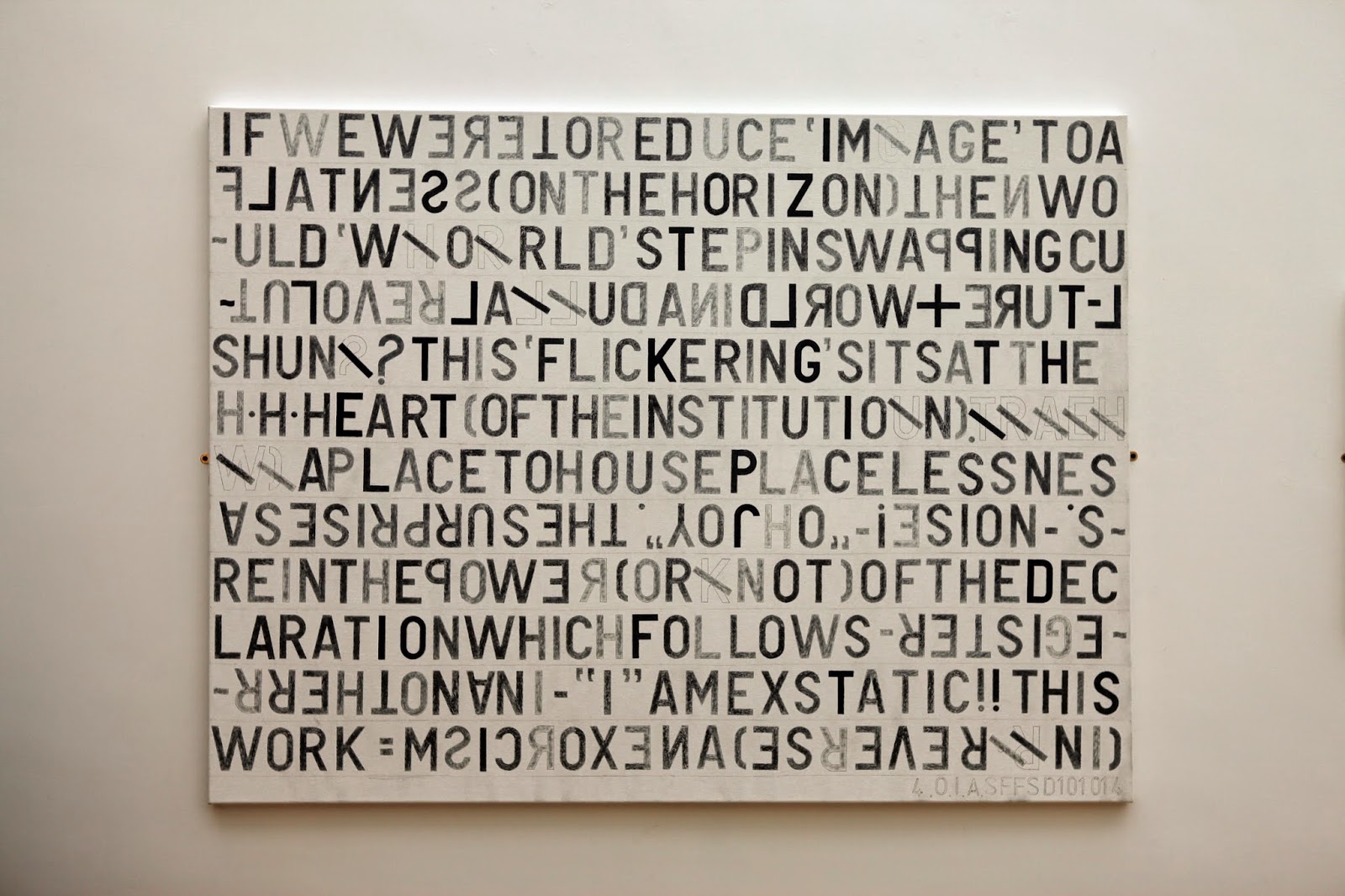
Midpointness is a proposal for an evolving project that explores how works of art and work can be seen to be in a state of ‘being in the midst’, a place W. T. J. Mitchell has termed aninescapable zone of transaction”. We propose to put focus onto the ‘work’ of knowledge as a process of becoming, as opposed to a process of advancement. The initial premise grew from conversation on 3rd February 2015 between Andrew and I in front of one of my text-paintings which reads;

The work is a score performed in the mind.
  The world is a work performed in the words
  The mind is a work performed in the world

Let us consider the work of art is here is to be understood as art’s labour and the process of becoming and to some extent performing, as much as an artefact as of and in itself. This proposal seeks to foreground the dynamics of inner/outer dialogue and other potentials that an artist might hope for when he/she explores the generative potential of the work of art.

Our aim is the curatorial equivalent of lifting the footnote to the status of the main body of text (and possibly vice versa). The methodology for the exhibition/project envisions a ‘toing and froing’ position between authorship and reception. The proposal suggests that the ‘centre’ (the work and/or the text) and its surrounding universe are completely indivisible. As such the principle of footnotes will filter through to the whole project, with visual and textual ‘footnotes’ infiltrating the exhibition’s ethos and design; the footnotes being analogous to the surrounding constellations within which the ‘centre’ sits, swapping footnotes for centre and vice versa.

We propose a generative project  which over time gets dismantled and reconstructed/imagined by the gradual accretion and classifying of the surrounding connections, associations, influences of the curators, artists, students and other audiences. These can be in the form of artworks, texts, artefacts, performances or other interventions. We are identifying the surrounding ‘stuff’ of the ‘work’ as an equivalent to the footnotes of a text.

We will curate different events  which will punctuate and inform the future shape and display of the project. The dialogue generated from these discussions, readings, film screenings etc. will effect, inform and direct the focus of the classifying of the 'footnotes’ and the generation of new ones. Using a cosmic model the ‘footnotes’ for the works in the exhibition will be classified and presented by different shifting, signalling systems of measurement and value such as near and far, small and large, bold and faint, how big, how dense, how inscribed, how intense, rather than by any chronological teleology.

A non-fixed classification process is defined through dialogue, events, conversations, catalysts.  Participants occupy the process and thus the outcome is a necessary outcome of being generative as opposed to being worked out prior.  

The time-plan is a considerable part of the project and will constitute a work of practice in itself. The time plan is imagined as a SCORE which will be created during the residency period.

I'll try to keep a blog going during the process as things come and go.


Friday, 8 May 2015

Text versus a piece of Art


Text and Work
Part 1

There are clear precedents for exploring the territories which are overlapping in the not so simple play-off between "Text" and "Art". It has been well documented and argued elsewhere that U.S. and U.K. ‘conceptual art’ was wrestling with the philosophical and aesthetic relationships between art and text, art as text, text as art, word and image, word as idea, the literary versus non-literary etc. from the outset.  Within the context of the ‘contemporary’ (by which I mean here the post-conceptual and/or even post-historical) Text in art is as much a ubiquitous a means of production as any other a medium within the realm of what we might commonly understand as, ‘contemporary art’.

So why then am I working with ‘text’ in the context of ‘art’?  By working with text what I am I really doing? Indeed, why do I concern myself with it as a question at all?

I’m asking these questions because I’m working on a paper for a conference entitled, ‘Text Versus a piece of Art’ in Łódź next week. As usual I’m still pretty clueless, but as I’ve written before, this cluelessness may be a valuable commodity (albeit a fragile one) in the over purposive territory of the ‘artademy’(© Dutton) . What I’m initially trying to focus on, or better, the place I’d like to work within, is a territory which is implied by the application of the proposition, 'Versus' which is set between the nouns 'Text' and 'Art' in the conference title,  'Text versus a piece of Art'.  

Versus can be understood to signify a turn toward or against. In other words it can be suggestive of an antagonism, ‘against’, or as a comparison, ‘with’. Either way, the proposition is used to declare a necessarily pre-existing sense of some classificatory difference between two ‘concept-things’, with the difference which is presupposed (or summoned) by the versus being the central distinction between those two ‘concept-things’ at that given moment of co-habitation. However, although versus presupposes and summons difference and distinction, it must also assume some sense of familial similarity within which to identify the distinctions (race horse versus race horse, octopus versus squid, not race horse versus squid).[1]

In any case, the antagonism suggested by the conference title doesn’t stop at the level of ‘between Text and Art’ because the actual conference title is of course ‘Text versus a piece of art’ (my italics).

So here, does the ‘piece of Art’ refer to an ‘object’, an ‘Artefact’ or an ‘idea’, a framed something-or-other (framed in the broadest sense) which exists as ‘piece of Art’ in the context of all the other ‘pieces of Art’ which are both being produced, have been produced and are yet to be produced? Is the ‘piece of Art’ more or less than Art as a totality because it is merely a piece? Or is the ‘piece’ a fragment of the chaos of the totality made safe[2]. Certainly one might presume that to be a ‘piece of art’ at all, there must be larger corpus of which to be a piece of.  Is art then a ‘piece’ of this meta-‘art’?  Does Art call upon this Art-as-totality by invoking it in fragments because the fragment is the only way to understand the whole? Is this a way of slowly immunising ourselves to chaos, to preparing for it, or to fall in love with it?

And yet, and yet.. again the title of the conference is ‘Text versus a piece of Art’.

Not, ‘A Text versus a piece of Art’, nor ‘Text versus Art’, but categorically, as if to underline the fact, a transcendental whole (TEXT). So whole it needs no definite article (like GOD), versus some form of a fragment, a sliver, or a slice ( A PIECE OF ART ) of that which also commands no THE.

What a titanic struggle this is turning out to be.

I suspect that what is at stake then, in the phrase ‘Text versus a piece of Art’ is going to have some theological undertones. That it is not so much a fight for territory or meaning of each term, as much as an enquiry and even an evocation of a form of oppositional irresolution, a lens though which we might try to understand the terms as existing within a singular and dynamic whole, and if this is the case, a question of what this whole might be.

Here, the proposition versus is already first placing ‘text’ and ‘a piece of art’ into a familial field in order then to subdivide once  more them into more precise categories from which to retrieve them in new formations, producing a new ‘sense’ of Text and versus a piece of Art. Both Text and Art are checking each other out, are about to be transformed by their mutual re-assessment and love-in during the discursive course of the conference paper.

It is precisely this contradictory territory, between the whole and the fragment, the general and the particular, the image and the text which is conjured up by the conference title that I want to try to explore as a means towards understanding what might be possible in and through the work of art which approaches itself through text, or the text which approaches itself through art, with a longer view on what thinking and seeing within these oppositions might mean for ‘experience’ or ‘world’ and in particular what this might mean in respect of ‘time’.

As a maker, I recognise a ‘value’(a quality perhaps) of evolving criteria from within the ‘work’ of art (in the spirit of  immanence ) so, in the spirit of this work, I can only begin here by recognising the proposition of two differing and seemingly mutually exclusive totalities which are also  entirely intertwined as they are being presented to me in the conference title alone. My criteria for this paper must originate then from within here and here alone, from this stand off of two totalities; on the one hand the totality of Text, the über Text which enmeshes all texts which come before after and within, and on the other the totality of the thing (Art) of which we can only make sense by making reference to a fragment (a piece), a totality which is so unknowable and Chaotic we must access it via an agent (a piece of art), the cipher or the fragment, all of which elements are subsumed under the generic classification of what ever this new work thing is yet to be called .


So, I’m approaching this division (the versus of art and text) as a spatial, conceptual and temporal territory which I might inhabit, or in the spirit of my recent work, temporarily occupy. This territory, which orientates around that which may or may not be considered a piece of art, that which may or may not be considered Text (and as a consequence what may or may not be considered an image?), is key not because I’m too concerned with defining what is or isn’t anything else, (I’m happy with Reinhardt on this one) but because that territory of inconclusiveness might also be as of itself, a means, a movement of occupation towards an affective realm within a practice/life/world in which the ontological flickering between states of being emerges as a form of  aesthetic affect ( by which I mean here what Peter Osbourne describes as being ‘felt by the mind’[3]). In short, the production of an interior reflexive zone within which what is proposed to happen is also felt in the process of it happening. Or to be more precise, to suggest that the proposition itself is ‘felt by the mind’ AS a proposition as it becomes, not merely understood as one after the fact, not a spatial zone but territory of time experienced and felt by the mind.


[1] What would be purpose of random oppositions, of comparing a race horse to a squid? The purposelessness might indeed be the purpose.
[2] ( see Elizabeth Grosz, “Chaos, territory, art”).
[3] see Peter Osbourne, Anywhere if not at all, London, Verso (2013)  p. 45.

the world is a score


Friday, 23 May 2014

Two kinds of space

I've been quiet but I'm feeling gradually noisier of late.

Not to get too personal but sincere gratitude to all those of you who have been, and remain there for me, both at the frontline and/or quietly being there in the background.

As a way back  I'm looking through some notebooks and found these quotes. Thanks to L for these.

From  Camus'

The Sea Close By 

"Without space there is neither innocence nor liberty! When a man cannot breath, prison means death or madness ; what can he do but kill and possess?"

 From Rilke's

Letters to a young poet

"With nothing can one approach a work of art so little as with critical words: they always come down to more or less happy misunderstandings.
Things are not all so comprehensible and expressible as one would mostly have us believe: most events are inexpressible, taking place in a realm which no word has ever entered and more inexpressible than all else are works of art, mysterious existences, the life of which while ours passes away, endures"


Tuesday, 9 July 2013

experiment and play


It's no wonder I've been struggling of late, not simply due to lack of time ( though this is a serious issue ), but also because I begin to realise that I've been missing something in the work.

If I could reduce all images and words to some form of flatness/sameness, then would 'world' take over, using the images and words as some form of platform on which to perform? This is not to say that I don't value inconsistency and waywardness, and all those unruly actions, but I guess I don't want to fetishise these behaviours at the expense of allowing room for something else to creep in, something akin to ontological breaks, or bursts, for example. Oddly, for work that I have always maintained was like a form of inversion, I may have got things inside out and back to front.

Lately then I've taken to writing simple statements on paper and seeing how they 'hold up' and something about this process is starting to become interesting. I've started to put some black grounds down on canvas again ( after 20 years ) on which I propose to write a statement ( or in some cases a drawing ) in white.  There's  not a great deal of variation in scale, material, colour, but for some reason I feel that they are  starting to allow something to take place without all the hullabaloo of previous work.

I wonder if I've been confusing  'experiment' with 'play'?