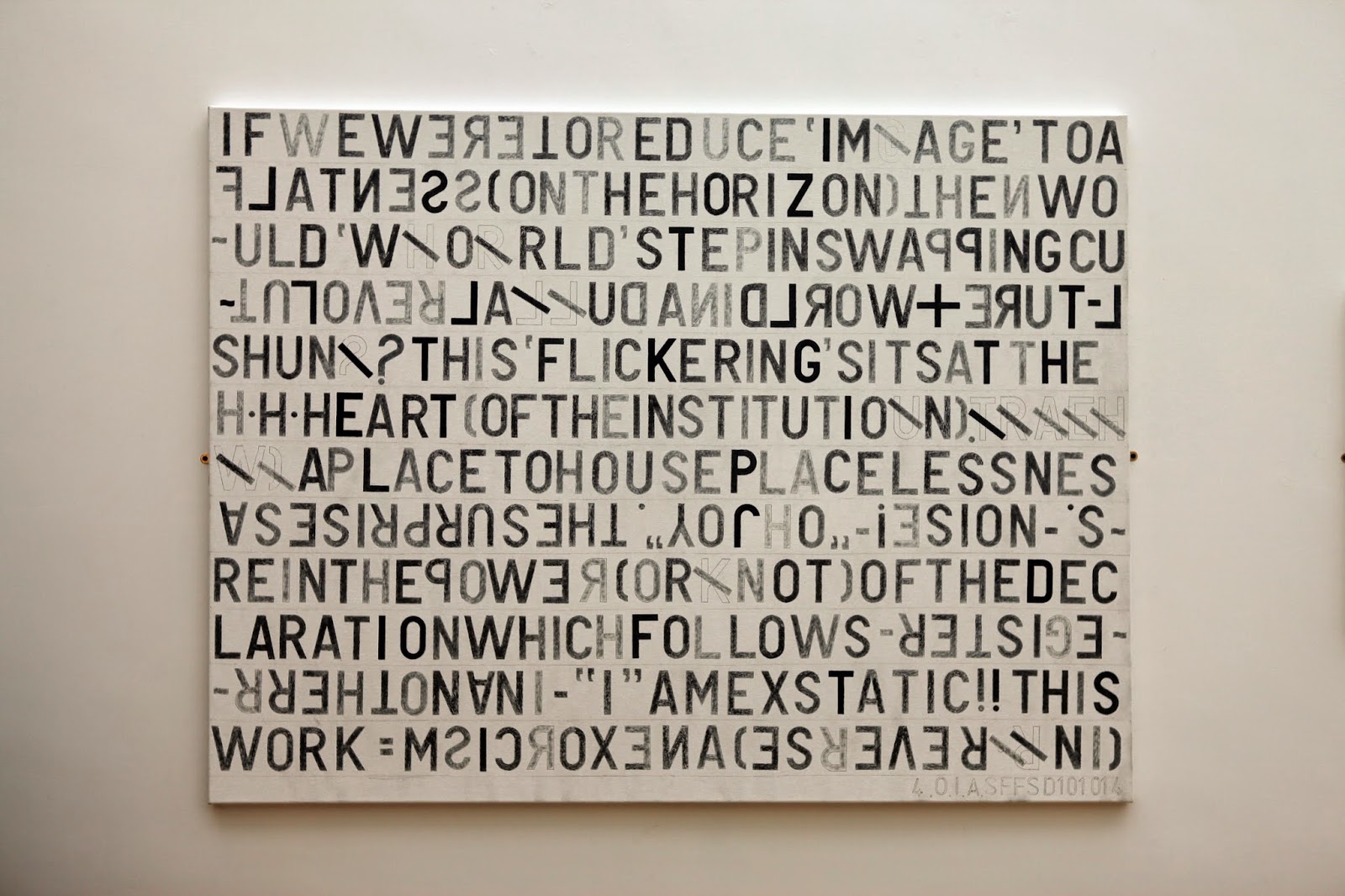
Friday, 8 May 2015

Text versus a piece of Art


Text and Work
Part 1

There are clear precedents for exploring the territories which are overlapping in the not so simple play-off between "Text" and "Art". It has been well documented and argued elsewhere that U.S. and U.K. ‘conceptual art’ was wrestling with the philosophical and aesthetic relationships between art and text, art as text, text as art, word and image, word as idea, the literary versus non-literary etc. from the outset.  Within the context of the ‘contemporary’ (by which I mean here the post-conceptual and/or even post-historical) Text in art is as much a ubiquitous a means of production as any other a medium within the realm of what we might commonly understand as, ‘contemporary art’.

So why then am I working with ‘text’ in the context of ‘art’?  By working with text what I am I really doing? Indeed, why do I concern myself with it as a question at all?

I’m asking these questions because I’m working on a paper for a conference entitled, ‘Text Versus a piece of Art’ in Łódź next week. As usual I’m still pretty clueless, but as I’ve written before, this cluelessness may be a valuable commodity (albeit a fragile one) in the over purposive territory of the ‘artademy’(© Dutton) . What I’m initially trying to focus on, or better, the place I’d like to work within, is a territory which is implied by the application of the proposition, 'Versus' which is set between the nouns 'Text' and 'Art' in the conference title,  'Text versus a piece of Art'.  

Versus can be understood to signify a turn toward or against. In other words it can be suggestive of an antagonism, ‘against’, or as a comparison, ‘with’. Either way, the proposition is used to declare a necessarily pre-existing sense of some classificatory difference between two ‘concept-things’, with the difference which is presupposed (or summoned) by the versus being the central distinction between those two ‘concept-things’ at that given moment of co-habitation. However, although versus presupposes and summons difference and distinction, it must also assume some sense of familial similarity within which to identify the distinctions (race horse versus race horse, octopus versus squid, not race horse versus squid).[1]

In any case, the antagonism suggested by the conference title doesn’t stop at the level of ‘between Text and Art’ because the actual conference title is of course ‘Text versus a piece of art’ (my italics).

So here, does the ‘piece of Art’ refer to an ‘object’, an ‘Artefact’ or an ‘idea’, a framed something-or-other (framed in the broadest sense) which exists as ‘piece of Art’ in the context of all the other ‘pieces of Art’ which are both being produced, have been produced and are yet to be produced? Is the ‘piece of Art’ more or less than Art as a totality because it is merely a piece? Or is the ‘piece’ a fragment of the chaos of the totality made safe[2]. Certainly one might presume that to be a ‘piece of art’ at all, there must be larger corpus of which to be a piece of.  Is art then a ‘piece’ of this meta-‘art’?  Does Art call upon this Art-as-totality by invoking it in fragments because the fragment is the only way to understand the whole? Is this a way of slowly immunising ourselves to chaos, to preparing for it, or to fall in love with it?

And yet, and yet.. again the title of the conference is ‘Text versus a piece of Art’.

Not, ‘A Text versus a piece of Art’, nor ‘Text versus Art’, but categorically, as if to underline the fact, a transcendental whole (TEXT). So whole it needs no definite article (like GOD), versus some form of a fragment, a sliver, or a slice ( A PIECE OF ART ) of that which also commands no THE.

What a titanic struggle this is turning out to be.

I suspect that what is at stake then, in the phrase ‘Text versus a piece of Art’ is going to have some theological undertones. That it is not so much a fight for territory or meaning of each term, as much as an enquiry and even an evocation of a form of oppositional irresolution, a lens though which we might try to understand the terms as existing within a singular and dynamic whole, and if this is the case, a question of what this whole might be.

Here, the proposition versus is already first placing ‘text’ and ‘a piece of art’ into a familial field in order then to subdivide once  more them into more precise categories from which to retrieve them in new formations, producing a new ‘sense’ of Text and versus a piece of Art. Both Text and Art are checking each other out, are about to be transformed by their mutual re-assessment and love-in during the discursive course of the conference paper.

It is precisely this contradictory territory, between the whole and the fragment, the general and the particular, the image and the text which is conjured up by the conference title that I want to try to explore as a means towards understanding what might be possible in and through the work of art which approaches itself through text, or the text which approaches itself through art, with a longer view on what thinking and seeing within these oppositions might mean for ‘experience’ or ‘world’ and in particular what this might mean in respect of ‘time’.

As a maker, I recognise a ‘value’(a quality perhaps) of evolving criteria from within the ‘work’ of art (in the spirit of  immanence ) so, in the spirit of this work, I can only begin here by recognising the proposition of two differing and seemingly mutually exclusive totalities which are also  entirely intertwined as they are being presented to me in the conference title alone. My criteria for this paper must originate then from within here and here alone, from this stand off of two totalities; on the one hand the totality of Text, the über Text which enmeshes all texts which come before after and within, and on the other the totality of the thing (Art) of which we can only make sense by making reference to a fragment (a piece), a totality which is so unknowable and Chaotic we must access it via an agent (a piece of art), the cipher or the fragment, all of which elements are subsumed under the generic classification of what ever this new work thing is yet to be called .


So, I’m approaching this division (the versus of art and text) as a spatial, conceptual and temporal territory which I might inhabit, or in the spirit of my recent work, temporarily occupy. This territory, which orientates around that which may or may not be considered a piece of art, that which may or may not be considered Text (and as a consequence what may or may not be considered an image?), is key not because I’m too concerned with defining what is or isn’t anything else, (I’m happy with Reinhardt on this one) but because that territory of inconclusiveness might also be as of itself, a means, a movement of occupation towards an affective realm within a practice/life/world in which the ontological flickering between states of being emerges as a form of  aesthetic affect ( by which I mean here what Peter Osbourne describes as being ‘felt by the mind’[3]). In short, the production of an interior reflexive zone within which what is proposed to happen is also felt in the process of it happening. Or to be more precise, to suggest that the proposition itself is ‘felt by the mind’ AS a proposition as it becomes, not merely understood as one after the fact, not a spatial zone but territory of time experienced and felt by the mind.


[1] What would be purpose of random oppositions, of comparing a race horse to a squid? The purposelessness might indeed be the purpose.
[2] ( see Elizabeth Grosz, “Chaos, territory, art”).
[3] see Peter Osbourne, Anywhere if not at all, London, Verso (2013)  p. 45.

the world is a score


Friday, 23 May 2014

Two kinds of space

I've been quiet but I'm feeling gradually noisier of late.

Not to get too personal but sincere gratitude to all those of you who have been, and remain there for me, both at the frontline and/or quietly being there in the background.

As a way back  I'm looking through some notebooks and found these quotes. Thanks to L for these.

From  Camus'

The Sea Close By 

"Without space there is neither innocence nor liberty! When a man cannot breath, prison means death or madness ; what can he do but kill and possess?"

 From Rilke's

Letters to a young poet

"With nothing can one approach a work of art so little as with critical words: they always come down to more or less happy misunderstandings.
Things are not all so comprehensible and expressible as one would mostly have us believe: most events are inexpressible, taking place in a realm which no word has ever entered and more inexpressible than all else are works of art, mysterious existences, the life of which while ours passes away, endures"


Tuesday, 9 July 2013

experiment and play


It's no wonder I've been struggling of late, not simply due to lack of time ( though this is a serious issue ), but also because I begin to realise that I've been missing something in the work.

If I could reduce all images and words to some form of flatness/sameness, then would 'world' take over, using the images and words as some form of platform on which to perform? This is not to say that I don't value inconsistency and waywardness, and all those unruly actions, but I guess I don't want to fetishise these behaviours at the expense of allowing room for something else to creep in, something akin to ontological breaks, or bursts, for example. Oddly, for work that I have always maintained was like a form of inversion, I may have got things inside out and back to front.

Lately then I've taken to writing simple statements on paper and seeing how they 'hold up' and something about this process is starting to become interesting. I've started to put some black grounds down on canvas again ( after 20 years ) on which I propose to write a statement ( or in some cases a drawing ) in white.  There's  not a great deal of variation in scale, material, colour, but for some reason I feel that they are  starting to allow something to take place without all the hullabaloo of previous work.

I wonder if I've been confusing  'experiment' with 'play'?

Tuesday, 12 March 2013

Wednesday, 27 February 2013

Possession ( 1 )

Been a bit quiet of late, much to do in the day job, but have also been working on this.
Possession ( 1 ) for Bangkok Art and Culture Centre.

http://www.bacc.or.th/event/Exhibition-Possession-.html

I'll be using the Blog to post a few pics during the installation.
Also, Axis will shortly be publishing a small article of mine about Gwangju 2012 Biennial.


Saturday, 20 October 2012

Clueless


Being Clueless

I'm in Seoul, been here for 24 hours to work with some friends and colleagues at Kookmin University here, and also to visit Guangju and Busan Biennials, along with Seoul Media City, if at all possible in a short timescale.
However, I haven't been out of the hotel yet, due to various work committments. One of which was the urgency of the demand to get some of my work up on the University Repository. Like keeping on top of blogs, such as  this, sometimes it feels like time may be better spent.
Having said that, I just came across this, something I did for a conference a while back in 2010 I think. Its still not ready to be 'published', all sorts of opinions and loose ends, but I thought it might be interesting to one or two people. Especially if they get as lost as I do sometimes.
here we go.....apologies to the purists, and I'll sort the references out later.

'At a recent gallery opening of the work of Terry Atkinson as part of Lanchester Gallery Projects in Coventry in the UK, I got talking to an artist friend, lets call him, ‘M’, and both of us were singing the praises of a certain mutual acquaintance, lets call him ‘D’, who happened to be ‘cropping up’ all over the place, in shows, in magazines and his writings and even his teaching was also being talked about.  Whether it was a genuine pleasure to see our friend doing so well is a another question, but when my friend ‘M’ made the point that ‘D’, “was really focussed and knew what he was doing”, then adding slightly mournfully, “I wish I did, I feel utterly clueless most of the time”, I pricked up my ears. What struck me firstly was the fact that I thought the work of ‘M’ was far better (by that I mean, more interesting, more compelling, more complex and more difficult to grasp) than the work of ‘D’, and secondly, that I felt an immediate sense of empathy with this sense of ‘cluelessness’. It seemed entirely appropriate that we would have this conversation within the context of work by Atkinson who has recently described the art world as a kind of ‘swamp’ and his own practice as a ‘practice of unease’[1], both terms which signal somewhat turgid, foggy, cloying or sticky processes and environments.

At first I thought that perhaps when we said that ‘D’ really “knew what he was doing”, we had momentarily lost track of exactly ‘what’ D was really doing (in terms of practice and in terms of what I thought ‘M’ did better), and had been seduced by how well ‘D’ was doing it (in terms of career trajectory and what ‘M’ was probably doing quite badly). In other words the line between ‘the work or the practice’ and ‘the career’ had somehow become muddied.

With the benefit of hindsight I started to realise that the reaction wasn’t simply just a ‘practice’ v ‘career’ stand-off (as very nicely outlined by Atkinson in the accompanying publication to his exhibition), though undoubtedly this will have been part of the issue, but that there was also a deeper tussle going on which felt like it could be termed either an affliction or acondition or indeed a symptom of cluelessness when it comes to a some contemporary art practice because I confess too to often feeling utterly clueless in my practice.

This cluelessness is often made evident by the strategic employment of a range of approaches and tactics within the practice and a palpable sense of dynamic tensions in the studio and in the installations themselves. It often seems as if there is no focus at all, only a series of collaged ‘events’, be they photographs, texts, sound works, drawings, animations etc which seem to float from one to another in what at first glance would seem and arbitrary and pointless manner. Yet, the idea of my work being ‘lost’, or ‘uneasy’, or ‘unfocused’ doesn’t worry me. Quite the opposite, it quite excites me. As does the work of others which seems to me to be existing in a dynamic of what Julian Stallabrass termed 'flickering perceptual states between' ………… when describing the impossibility of really pinning down the work of Liam Gillick, for example. I could even say I feel liberated by my condition. Think of Gillick for example, or Fischli and Weiss, or Arakawa and Gins, all of whom seem to operate on what could be called ‘borders’ of classification, moving in and out of positions of focus as is they were weaving a bike through traffic.

Of course, within the context of the academy this unruly methodology may be a problem, this apparent lack of direction and blundering around may indicate an absence of something necessary, and this could be altogether more serious, a lack of a sustainable intellectual argument perhaps, leading to the academic threat of the loss of esteem as a pre-conditioned reaction to a practice which does not appear to contribute to knowledge despite the fact that it is hard not to recognise that knowledge itself could be said to be in crisis.

But currently, even more withering than the threat of academic peer dismissal, might be the accusation of a shortfall of ‘artistic ambition’. It seems that neither the careerist artist nor the academic know quite what to do with notions of waywardness, complexity, tension, confusion, and contradiction as legitimate areas of exploration presumably because both ‘camps’ are built around an attitude of measurement and competition, be it the research council or the Turner prize and of course, measurement and competition are both games which Cluelessness doesn’t need to play.

It reminds me somewhat of Don Dellio’s “the names”, set here in Athens in fact, in which the lead character confesses to enjoying being a tourist because it is a licence for him to be an idiot and thus get to where he needs to go.

Perhaps this condition of apparent stunned perplexity for want of a better phrase is inevitable. As I am an artist, one half of the collaborative duo Dutton and Swindells, and a Professor in practice, I say what I say because I have a practice out of which emerges a recognition that it us important that the research driven academic community is also opened up to practice in much the same way as the practice community has been opened, and closed, by research agendas. Is it then not surprising then that the artist/academic is reduced to state of continual bewilderment as he or she stand at the cross roads of two very different approaches to ‘knowledge’, neither of which actually reflects what Gunthar Kress recently described as a ‘life –world’. That is, the suggestion that ‘society’ has been replaced by ‘life-world’, which is then defined by ‘life-style’. I.e. knowledge is that which I need now, which solves a problem for me.[2]

Cluelessness might well be an understandable, if slightly stupified, response to contemporary crises, political, economic and epistemological, a little like the rabbit caught in the glare of the headlights, stunned, transfixed, hypnotised by the oncoming truck. But unlike the rabbit that doesn’t know what’s coming, the artist is made clueless in realising quite how much he or she doesn’t know, and can only stare back in state of mute anticipation of oncoming forces. This is Cluelessness as a kind of dawning awareness of just how bad things are and thus a natural reaction to it. A kind of impasse.

But lets take it a step further. What if the condition is less an automatic response of ‘shut-down’ when faced with the complexity of everyday life, and something more a reactive means of survival? Less of a symptom and more of a mutation or evolution?

For example, should an artist admit to their wayward processes resembling some form of modus operandi then he or she is entirely ‘knowing’ about what he or she is (not) doing? In which case the artist is finely performing a lack of ‘performance’, focusing, via the invocation of diverse and contradictory strategies, on precisely this lack.

This brings us back to the notions of the ‘practice’ and the ‘career’. If the confusion in my original conversation with ‘M” is anything to go by, what may be suggested is a turn toward the foregrounding of the career as being central and I would suggest this to be vast oversimplification of practice.

A career has a trajectory, a practice expands. By virtue of the career dissecting the expanding sphere of the practice, the career is one-dimensional, the practice, multi-dimensional. And it here I am reminded of Paul Virillio’s model of knowledge; that of the expanding sphere. As the sphere of knowledge gets larger and larger, the surface area, which stands between what is known and what, is not yet known also increases.

In other words, the more we know, the more we know how little we know.

Cluelessness then, far from something to be ashamed of, may well be the first step towards developing a methodology of engaging in an extraordinary complex world in a new way, a way of opening up possibility, malleable to new forms and instructions. It is a the beginning of a potential proposition in the world which does not strive to reduce the world to over-simplified terms and effects, sound bites of modules of knowledge (and in this sense if profoundly non-representational).

So what might this really mean in practice? How do we think of this confusion and contradiction as a methodology of creatitivity? There would have to a tactical approach introducing malapropisms, mistakes, confessions, slippages, assemblages, reversals, blunders and blockages into the hyper smooth formations of contemporary knowledge production and production of the self.

If we take Ranciere’s notion of “aesthetic acts as configurations of experience that create new modes of sense perception and induce novel forms of political subjectivity”[3] it may be possible to consider cluelessness as attitude, or stance, rather than condition or symptom. As the fertile ground upon which, or space within which, these new modes of sense perception may start to flourish.

Cluelessness as a knowing refusal then, as opposed to a condition of helplessness, pre-supposes an end to what Ranciere calls the “unsatisfying mise-en-scene of ‘the end and the return that persistently occupies the terrain of art, politics and any other object of thought”[4]in that it is neither progressive or regressive. It is simply concerned with developing a language of movement in the here and now.

As Judith Butler suggest,

“There will be no meta-language- it will be the labour of transaction and translation which belongs to no single site-but is the movement between languages and has its final destination in this movement itself. Indeed the tasks will not be to assimilate the unspeakable into the domain of speakability in order to house it there, (as we must within the ‘research culture’) within the existing norms of dominance, but to shatter the confidence of dominance, to show how equivocal its claims to universality are and from that equivocation, track the break up of its regime- an alternative version of universality wrought from the work of translation itself.”[5]

To wind up.

David Bohm, in On Creativity suggests that we must ‘give patient and sustained attention to the idea of confusion’. 

Ultimately my argument is for a small scale re-aligning of what we mean by the term ‘practice’, particularly within the contexts of research driven agendas of the Art and Design Institutions and career orientated ‘business studies-fine art degrees’. That Practice would become the process within which conceptual models and propositions proliferate meanings and non-meanings, confusions and complexities to exist as and be understood as aesthetictensions, which are in turn attempting to exist outside of, or at least form some resistance to, and/or meaningful dialogue with, the ever encroaching realm of the neo-liberal simplification and commodification of cultural forms and processes, whilst simultaneously also beingimplicitly sceptical (by being in practice ) and resistant to the fetish of progress which drives the idea of ‘knowledge’ as defined within the contemporary Research Culture. In other words, a practice, which is defined by the line, it draws in its constant dynamic motion and tensions between the dominant spaces of culture and knowledge production.

Thinking once more about the words of Jacques Ranciere, ‘Aesthetics is the ability to think contradiction[6]’. Is there an argument that refuses to isolate waywardness or incomprehensibility or cluelessness as a lazy or uncritical approach, and indeed, on the contrary to suggest that such an approach is engaged, possibly politicised and recognises such attitudes as contradiction or confusion of as an aesthetic, libidinal and political forces.

If so, is it possible to argue that this impossibility (or difficulty) of classification, (which applies first and foremost to what we think we are doing, hence, if we don’t now what we are doing we are ‘clueless’), this refusal (or inability) to ‘focus’ is in itself a highly charged force which, at their centre promote a deeply profound and necessary critical distance and attempt at detachment in order to play within what could be seen as the atomising effects of the twin neo-liberal obsessions of enterprise and innovation, to the extent that an art practice can present another model of confusion, in which tensions and stresses, contractions and disturbances, mistakes and malapropisms have aesthetic and dynamic dimensions and effects which may experienced as a form of deep critical ‘pleasure’ and effect?

In the words of the Raqs Media Collective[7]
“The tree of life, and therefore of art, would be barren were it not for the fruit of occasional misunderstandings”.'


[1] I need to chase this up, but I found it in some of Peter Suchin's writing about Terry I think.
[2] Gunther Kress, Professor of Semiotics and Education at a recent ESRC funded conference on the Multi-modal Doctorate
[3] From the forward of the politics of aesthetics, Jaques ranciere, first page. Continuum books.

[4] Ibid
[5] Judith Butler ‘Open’ p69
[6] the politics of the aesthetic, first seen in Claire bishop article the social turn? Art forum..
[7] in E-Flux Journal no 14..